
Yash
Brahmbhatt
Mechanical Engineer
Design-to-Production Thinker
Aerospace Enthusiastic
Mechanical Engineer passionate about FEA & CAD and turning innovative designs into production-ready solutions
Welcome to my Site
Nose dive into the heart and mind of mechanical marvels. Explore projects, gain insights, and join the journey of continuous engineering exploration.
About Me

CURIOUS DYNAMIC INNOVATIVE
Versatile Ontario Tech Mechanical Engineering student proficient in CAD design, aerospace manufacturing (i.e., bearings), and multilingual communication. A dynamic leader with strong technical skills, committed to continuous learning, and driven by a passion for crafting innovative solutions that transform societal and technological.
Role:
-
Designer Associate Specialist at General Dynamics Land Systems-Canada
-
Mechanical Engineering Student (B. Eng) at Ontario Tech University
-
Mechanical Team Member at Ontario Tech Operations of Planetary Surfaces (O.T.O.P.S.)
-
Tech. Dev. Team Member at Ontario Tech Space and Rocketry (O.T.S.R.)
-
Production and Process Engineering Intern at Schaeffler Aerospace - Canada
Yash Brahmbhatt
MAJOR ACHIVEMENTS
🎯Demonstrated continuous improvement by addressing technical gaps through hands-on learning and applying new knowledge to deliver impactful outcomes in design teams, internships, and coursework.
🏭Led multi-phase automation/workflow- optimization projects at Schaeffler Aerospace, delivering a 33% boost in manufacturing efficiency through independent leadership, technical reporting, and continuous process
🦾Engineered a lightweight CNC arm manipulator, achieving a 20% weight reduction through FEA and topology optimization, while reinforcing concepts in ergonomics, CAD, and additive manufacturing.
📊Analyzed jet vane thermal performance by simulating convective heat transfer and sensitivity cases, identifying Copper and Inconel 718 as optimal materials, which improved the reliability of thrust vector control systems for repeated launches.
🔥Developed a multi-cycle thermodynamic simulator in Python with a custom GUI and automated reporting, showcasing the ability to integrate coding, thermodynamics, and UI design into a cohesive engineering tool
✈️ Successfully designed a series of aeroacoustic devices onto a testing landing gear (LAGOON Model), achieving a 2.5–3 dB noise reduction and correlating experimental data with transient CFD models that predicted up to 14.5 dB theoretical reduction.
20+
Projects Completed
15+
3+
CAD Simulations & Prototyping Projects
Systems, Programming, and Other Projects

Experience
May 2026 - Present
Designer Associate Specialist

General Dynamics Land Systems - Canada (GDLS-C)
-
CAD Specialist for Engineering Development & Technology
-
SKILLS: Siemens NX, Excel, DFM, FMEA

Jun 2026 - Present
Oct 2025 - May 2026


Rover Mechanical
Design
Team Member
Ontario Tech Operations on Planetary Surfaces (OTOPS)
-
Developed teamwork, problem-solving, and hands-on engineering skills by collaborating on designing, testing, and integrating a rover
-
Established the role of Support Lead, focusing on mass and FEA analysis, teaching new members on CAD and simulations
SKILLS: SolidWorks, Excel, FEA
Tech. Development
Team Member

Ontario Tech Space Rocketry (OTSR)
-
Developed teamwork, problem-solving, and hands-on engineering skills by collaborating on designing, testing, and integrating a model rocket and its components for high-performance launches.
-
Integrated propulsion, avionics, and mechanical systems within a multidisciplinary R&D team, resolving design conflicts and enhancing cross-functional collaboration.
-
Led design reviews and system troubleshooting, improving team output by strengthening technical communication, leadership, and problem-solving.
SKILLS: SolidWorks, Thermal Analysis, Excel, FEA
Nov 2024 - Oct 2025


May 2023 - Sep 2024
Production & Process Engineering Intern

Schaeffler Aerospace

-
Ensured adherence to scope, time, and budget while leading the design and implementation of crucial machinery like CMM and Renishaw Equator. Drove technical enhancements for quality, cost, and efficiency.
-
Ensured precision in bearings manufacturing with GD&T expertise and conducted machine capabilities studies using engineering statistics.
-
Developed guides for operators, optimizing production and maintenance. Built strong client relationships with Schaeffler Groups and others. Excelled in roles as an engineer and leader.
-
Collaborated with project and team leaders for alignment with company goals, ensured compliance with regulations, and managed scraps for the Equator Project.
SKILLS: Bearing Analysis, Metrology, Autodesk Inventor, FEA, Excel, Manufacturing Process Improvement, SQL, Programming, SAP Implementation, Quality Control, Engineering Mathematics, Engineering Drawings, Statistical Analysis, MODUS1, PC-DMIS, CMM
Cadet Instructor
(F.Sgt)

132 Spitfire Squadron - Air Cadets
-
Improved my leadership skills by creating lesson plans, conducting drills with youths, and teaching various topics related to military knowledge.
-
Proven record of maintaining a high level of responsibility and being receptive to training and instruction, by receiving promotions throughout the Cadets program.
-
Successfully mediated conflicts and resolved disputes among squadron members, promoting harmony and unity within the unit.
SKILLS: Leadership
Sept 2019 - Sep 2020

Technologies and Tools Used...
SolidWorks
Siemens NX
Autodesk Inventor
FEA
Fusion360
Visual Code
AutoCAD
MATLAB
Python
C++
SQL
Arduino UNO & NANO
ROS
MODUS1
PC-DMIS
Raspberry Pi
Nastran
PyCharm
SAM
Office 365
Google Suites
Excel
VBA Code
SAP
Excel
Visual Studio Code
OpenRocket
SIMULINK
CFD
Drafting
Topology Optimization
CAM
CAE
CMM
LIDAR
Thermal Analysis
Mobile Robots
Additive Manufacturing
Industrial Robotics
Manufacturing Processes
IPA
RPA
Quality Control
Equator 500
MAHR
MPIs
Zeiss

Design Projects & Other Projects
Showcase
High School Projects (2018-20)
One Lunger Engine Design, Grade 10 Technology Design (Apr 2018 - Jun 2018)
What (Task/Objective):
-
Designed and optimized a one-lunger engine.
-
Addressed design challenges in the engine model.
-
Aimed for precision and understanding of component interactions.
How (Method/Process):
-
Acquired advanced skills in Autodesk Inventor.
-
Navigated Autodesk Inventor tools for intricate 3D modeling.
-
Applied principles of mechanics, thermodynamics, and combustion.
-
Used critical thinking and creativity to solve design issues.
-
Delved into component interactions and assembly processes
Results (Outcomes/Impact):
-
Ensured accurate representation of each engine component.
-
Optimized design and functionality of the one-lunger engine.
-
Demonstrated effective problem-solving in technical contexts.
-
Deepened understanding of engine systems and design precision.
Protégo: Concussion Mouth-guard Design and Demonstration(s), Grade 10-11 Technology Design (Sep 2018 - Dec 2018)
What (Task/Objective):
-
Developed an innovative solution in the sports industry to prevent concussions and improve diagnostic accuracy for physicians.
How (Method/Process):
-
Integrated a gyroscope and impact sensor into a mouthguard to collect impact data.
-
Designed prototypes and final product using Autodesk Inventor.
-
Programmed sensors using Arduino and C++ to enable real-time data capture.
Results (Outcomes/Impact):
-
Delivered a functional and accurate product that met its core goals.
-
Gained valuable lessons on improving both the product design and development process for future iterations.

Detailed CAD Model of a One-Lunger Engine Created in Autodesk Inventor – Showcasing Piston-Crank Assembly, Valve Train, and Component Interactions

Innovative Smart Mouthguard to Enhance Concussion Diagnosis Accuracy – Featuring Real-Time Impact Data from Embedded Sensors.
1st Year Of Mechanical Engineering
(2021-22)
BINGO! Automata Design and Simulation(s), ENGR 1025U Engineering Design
(Feb 2021 - Apr 2021)
What (Task/Objective):
-
Collaborated in a team of seven to design and simulate an interactive and unique toy automata for the Engineering Design Final Project.
-
Aimed to create a durable, engaging, and well-documented prototype.
How (Method/Process):
-
Iterated through seven sketch versions, evaluating and refining the prototype concept.
-
Developed Customer Needs Assessments, Design Specifications, and performed the Concept Selection Process.
-
Simulated the final prototype using SolidWorks (expanded view, motion study, 3D analysis, and engineering drawings).
-
Created Gantt charts and a comprehensive final design report.
-
Practiced and applied engineering communication skills to effectively present the project.
Results (Outcomes/Impact):
-
Delivered a unique and functional virtual prototype that showcased interactivity and durability.
-
Gained hands-on experience in SolidWorks and design documentation.
-
Improved team collaboration and engineering communication skills, preparing for future professional design challenges.

A Unique, Interactive Automata Simulated in SolidWorks, Showcasing Motion Study and Mechanical Design Innovation
2nd Year Of Mechanical Engineering
(2022-23)
Landing Gear Assembly and Design(s), MECE 2310U Concurrent Engineering
(Oct 2022 - Dec 2022)
What (Task/Objective):
-
Collaborated in a team of five to design aircraft landing gear while learning about its function, safety considerations, and engineering significance.
How (Method/Process):
-
Used SolidWorks to model, simulate, and analyze the prototype design.
-
Captured simulation videos for demonstration and data collection.
-
Constructed a physical prototype using Meccano kits, testing through iterative stages.
-
Applied engineering communication skills to present the final project effectively.
Results (Outcomes/Impact):
-
Successfully developed a functional and tested landing gear prototype.
-
Gained practical insight into aerospace applications, safety, and quality standards.
-
Strengthened skills in CAD modeling, prototyping, teamwork, and technical presentation.
Bipedal Automated Rickshaw Design - (MAJOR-Project for MECE-2310)
(Oct 2022 - Dec 2022)
What (Task/Objective):
-
Designed and developed a bipedal autonomous mechanical walking rickshaw pulling mechanism to produce a functional prototype within tight constraints.
How (Method/Process):
-
Used SolidWorks CAD to model and simulate the design.
-
Led multiple design iterations by analyzing gearing mechanisms, testing prototypes, and researching customer needs.
-
Planned and tracked the project using a Gantt chart and created a detailed Bill of Materials (BOM) to manage parts and timelines effectively.
Results (Outcomes/Impact):
-
Successfully built a functional prototype despite budget and part limitations.
-
Improved stability and durability through iterative refinement.
-
Demonstrated strong project management, technical communication, and collaborative engineering skills.

Innovative Bipedal Rickshaw Design – Autonomous Walking Mechanism Engineered for Efficient, Human-Free Pulling Under Budget Constraints
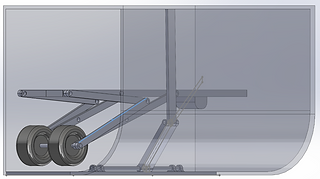
SolidWorks CAD of Landing Gear
Self-Learned Projects (2022)
Ball Bearings CAD Model/Assembly/Drawings (SUB-Project) (Oct 2023)
What (Task/Objective):
-
Advanced skills in Autodesk Inventor, with a focus on CAD proficiency, GD&T application, and understanding manufacturing processes, particularly ball bearing design.
How (Method/Process):
-
Mastered complex Inventor shortcuts to streamline the modeling workflow.
-
Practiced image rendering, assembly, and part drawings, and simulations such as animation and constraint-driven motion.
-
Applied GD&T principles within CAD projects to assess design feasibility and accuracy.
-
Investigated the anatomy and function of ball bearings, comparing them with other bearing types to deepen mechanical understanding.
Results (Outcomes/Impact):
-
Significantly improved design efficiency and precision in CAD modeling.
-
Gained practical experience in realistic part visualization and simulation.
-
Developed a strong foundation in engineering standards and manufacturing compatibility.
-
Built a deeper comprehension of ball bearing design and application differences, enhancing design decision-making for mechanical systems.

A CAD model of a Ball bearing with inner ring, outer ring and cage attached in the assembly
Airplane Model Boeing 747 CAD Model/Assembly/Drawing (SUB-Project)
(Nov 2023)
What (Task/Objective):
-
Gained expertise in creating intricate 3D models with an emphasis on both technical precision and visual aesthetics.
How (Method/Process):
-
Used advanced CAD software to develop complex geometries.
-
Conducted in-depth research using reference materials and technical documents.
-
Applied precise measurements to ensure accurate scale and proportion.
-
Focused on detailing, texturing, and refining the overall aesthetic presentation.
-
Learned to present final models visually, merging functionality with design impact.
Results (Outcomes/Impact):
-
Produced high-fidelity 3D models that met both technical and visual standards.
-
Strengthened technical research and CAD design accuracy.
-
Demonstrated professional-level modeling and presentation capabilities, enhancing both engineering communication and design value.

A CAD model of Boeing 747 using splines features and planar projections
Internship as Process Engineering Intern @ Schaeffler Aerospace
(May 2023-Sept 2024)

Equator-500s Production and Digitalization
(June 2023 - Sept 2024)
What (Task/Objective):
-
Led performance optimization of the Equator-500s system to enhance aerospace workflow efficiency.
-
Improved training, documentation, and cross-departmental coordination.
-
Performed engineering analyses to inform data-driven process improvements.
How (Method/Process):
-
Used SQL, VBA, Python/C++, MODUS1, and PC-DMIS to automate metrology and streamline system performance.
-
Deployed training programs and created detailed documentation using Office 365 and SAP.
-
Conducted Gage R&R, Cp/Cpk, and GRR studies for data validation and system refinement.
Results (Outcomes/Impact):
-
Achieved a 33% improvement in system performance and a 20% increase in workflow efficiency.
-
Enabled operator independence and long-term scalability through comprehensive documentation.
-
Informed strategic process integration and continuous improvement using advanced engineering analysis.

An example of an assmebeled Equator 500 without a fixture stand and rails
Machine Capabilities Studies
(Feb - Mar 2024)
What (Task/Objective):
-
Gained experience in machine operation, quality assurance, and manufacturing optimization.
-
Aimed to ensure part accuracy, compliance with standards, and efficient process execution.
How (Method/Process):
-
Operated machinery with precision, verifying measurements against technical drawings.
-
Performed inspections and testing to validate parts against industry standards.
-
Analyzed machine performance data to detect trends and improve efficiency.
-
Managed machine capability studies, overseeing task coordination and deadline management.
Results (Outcomes/Impact):
-
Improved measurement accuracy and part conformity.
-
Developed a strong understanding of quality control protocols and data-driven process improvement.
-
Enhanced skills in project planning, time management, and cross-functional execution.
MPI's Clamp and Piping System Design
(March 2024)
What (Task/Objective):
-
Created technical designs, supported prototyping, and resolved operational issues to improve execution and collaboration on the shop floor.
How (Method/Process):
-
Used AutoCAD to generate precise, operator-friendly technical drawings.
-
Leveraged 3D printing technology to produce physical prototypes and components.
-
Applied problem-solving skills to address operational challenges and optimize processes.
-
Promoted teamwork and open communication among operators to share insights and resolve issues collaboratively.
Results (Outcomes/Impact):
-
Enabled clearer task execution through high-quality design visuals.
-
Improved hands-on understanding of designs via physical prototypes.
-
Streamlined workflows and increased process efficiency by 25%.
-
Strengthened team cohesion and communication, fostering a more collaborative work culture.

MPI Clamp and Piping System – Engineered for Structural Stability and Fluid Routing Efficiency Using Precision CAD Modeling and Design Standards.
3rd Year Of Mechanical Engineering
(2024-25)
Manual CNC Arm Manipulator Design
(September 2024-December 2024)
What (Task/Objective):
-
Designed and developed a CNC door arm attachment to assist in lifting heavy components, with a focus on improving workplace safety, reducing physical strain, and supporting injured workers' recovery.
How (Method/Process):
-
Employed additive manufacturing (3D printing) to prototype and build the arm.
-
Created a scalable design using advanced CAD tools such as Siemens NX and iterative simulations to refine functionality and structural strength.
-
Collaborated cross-functionally to solve feasibility, economic, and ergonomic challenges during development.
Results (Outcomes/Impact):
-
Delivered a functional and ergonomic CNC manipulator, promoting safer handling of heavy components.
-
Achieved reduced physical strain on machinists and boosted recovery support for injured workers within a 5-25 lbs load with a 1:5 scale.
-
Developed a scalable, manufacturable solution with real-world impact on safety and efficiency in the shop environment.

A CAD model of PLA designed Manual CNC Arm Manipulator using Siemens NX
Safe Design of a Stepped Shaft and its Analysis (MAJOR-Project for MECE 3220U)
(Feb 2025 - Apr 2025)
What (Task/Objective):
-
Designed and analyzed a stepped shaft to meet structural integrity and safety standards, targeting a minimum safety factor of 1.5.
How (Method/Process):
-
Used SolidWorks for FEA analysis to simulate loading conditions.
-
Performed manual calculations for maximum shear and normal stresses, along with fatigue and bending moment analysis.
-
Optimized geometry and selected materials to ensure durability.
-
Created a professional engineering report with all supporting documentation, modeling, and justifications.
Results (Outcomes/Impact):
-
Delivered a structurally sound shaft design with infinite life expectancy.
-
Met industry design safety standards with a validated safety factor ≥ 1.5.
-
Showcased strong technical documentation, analytical thinking, and design communication skills.

FEA-Validated Stepped Shaft Model – Designed for Reliability with Calculated Shear, Bending, and Fatigue Stress Limits with SolidWorks

A Cross-Section of the CAD Model Stepped Shaft demostrating the dimensions and tolerancing using hand calculations, Excel, Solidworks
Line Following and SLAM Integration for TurtleBot-3 Autonomous Navigation (MAJOR-Project for MECE-3390U)
(Jan 2025 - Apr 2025)
What (Task/Objective):
-
Developed a TurtleBot system for mapping, localization, and navigation, aiming to improve robotic autonomy and spatial awareness.
How (Method/Process):
-
Used ROS, LiDAR, and Python for system development.
-
Implemented SLAM, optimized path planning algorithms, and integrated sensor data for accurate real-time decisions.
Results (Outcomes/Impact):
-
Enhanced navigation accuracy and environmental perception.
-
Enabled precise obstacle detection, efficient routing, and autonomous movement in dynamic settings.
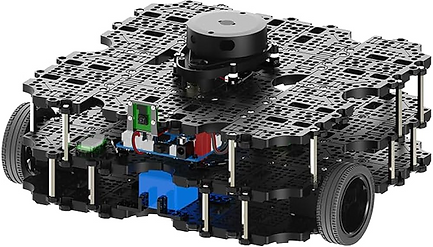
Waffle TurtleBot-3 with Pi Camera and LIDAR, Assembled
Projects as Tech. Dev. Team Member @ OTSR
(Nov 2024 - Oct 2025)

Thermal Performance Analysis of Custom Jet Vanes for Thrust Vector Control
(Jan 2025-Apr 2025)
What (Task/Objective):
-
Analyze the thermal performance of jet vane materials under rocket exhaust conditions
-
Identify the most suitable aerospace-grade material for thrust vector control applications
How (Method/Process):
-
Applied heat transfer principles to model thermal distribution
-
Considered three candidate materials: Copper, Inconel 718, and Aluminum
-
Collected motor thrust duration, vane geometry, and material properties → organized in Excel
-
Simulated convective heat transfer at h = 250 W/m²·K
-
Performed sensitivity analysis with h = 235 and 175 to study coefficient effects
Results (Outcomes/Impact):
-
Copper and Inconel 718 showed the best thermal resistance (~2900 K average)
-
Uniform temperature distribution reduced the risk of deformation across the vane length
-
Excel analysis confirmed a consistent cooling trend with distance
-
Sensitivity study validated robustness → ensured reliable use over multiple launches

Manufactured Copper Vanes used in the Rocket Jet Vane Thrust Control
Design and Development of a Load-Cell Test Stand for Measuring Jet Vane Thrust Vector Control Forces
(Dec 2024-Feb 2025)
What (Task/Objective):
-
Create a safe and stable test apparatus for jet vane thrust vector control systems
-
Enable accurate measurement of thrust forces for different vane designs
How (Method/Process):
-
Followed the engineering design cycle:
-
Rsearch
-
CAD modeling
-
Material selection
-
Manufacturing
-
Assembly
-
Testing
-
-
Integrated load cell and DAQ system for precise force measurements
-
Designed a test stand with modularity to accommodate multiple vane configurations
-
Conducted iterative testing to verify stability and reliability
Results (Outcomes/Impact):
-
Delivered a secure, accurate, and repeatable testing platform
-
Enabled evaluation of diverse vane materials and geometries
-
Expanded testing scope for both current academic work and future industrial applications
-
Provided a scalable solution for thrust vector control validation

Initial Drawing for the Test Stand for Jet Vane Thrust Vector Controls
Self-Learned Projects (2025)
Dual-Blade Rotary Gear Design
(Dec 2024 - Jan 2025)
What (Task/Objective):
-
Developed and animated a dual-blade rotary gear mechanism in SolidWorks.
-
Aimed to apply and deepen the understanding of kinematics and the theory of machines.
How (Method/Process):
-
Used SolidWorks to model and animate the mechanism.
-
Optimized link lengths to achieve accurate and controlled motion.
Results (Outcomes/Impact):
-
Gained a strong grasp of mechanical motion principles.
-
Improved proficiency in mechanism design, motion simulation, and theoretical application in CAD tools.

Dual-Blade Rotary Gear System – Exploring the Application of Kinematics and Theory of Machines through CAD Modeling and Motion Simulation
Airfoils CFD Analysis of NACA Profiles Using SolidWorks Flow Simulation
(Apr 2025 - May 2025)
What (Task/Objective):
-
Designed and simulated multiple NACA airfoils to assess aerodynamic performance under various angles of attack.
How (Method/Process):
-
Used SolidWorks Flow Simulation to conduct flow trajectory and pressure visualization.
-
Extracted lift (Cl) and drag (Cd) coefficients to analyze stall onset and aerodynamic efficiency.
-
Performed parametric studies, set surface goals, and analyzed streamlines to generate Cl/Cd vs. AoA plots.
Results (Outcomes/Impact):
-
Gained deep insights into airfoil behavior under changing flight conditions.
-
Demonstrated strong proficiency in CFD tools and aerodynamic theory.
-
Produced clear, data-driven comparisons to guide airfoil selection and optimization.

CFD Analysis of NACA Airfoil Profiles Using SolidWorks Flow Simulation: Lift, Drag, and Stall Evaluation
Thermodynamic Cycle Calculator & Simulator with Automated Report Generator (Python & MATLAB)
(May 2025 - Jul 2025 )
What (Task/Objective):
-
Designed and developed a thermodynamic cycle simulator that calculates and visualizes performance parameters of ideal cycles (e.g., Otto, Diesel, Rankine). The tool also generates an automated engineering report summarizing results and diagrams based on user input.
How (Method/Process):
-
Used Python for GUI, numerical computation (NumPy), and PDF generation (FPDF).
-
Plotted thermodynamic diagrams (PV/TS) with Matplotlib.
-
Validated early calculations using MATLAB to ensure accuracy.
-
Built functions to model key thermodynamic processes and link them to a simple, interactive input/output interface.
-
Integrated a report generator that outputs a clean, structured summary of results, including equations, user inputs, and graphs.
Results (Outcomes/Impact):
-
Successfully simulated multiple thermodynamic cycles with real-time feedback on efficiency, work output, and heat transfer.
-
Produced automated reports in PDF format with clean diagrams and labeled data.
-
Helped solidify understanding of thermal system modeling and introduced real-world engineering communication skills at an early stage.
-
Laid the groundwork for turning the calculator into a web-based engineering tool in future iterations.

UI/UX Design of Prompt pop-up of Otto Cycle Calculator & Simulator
Workcell Design for Efficient CNC-to-CMM Workflow with Automated Handling
(Aug 2025-TBD)
What (Task/Objective):
-
Designed an optimized manufacturing workcell layout to streamline the workflow between CNC machining and CMM inspection, minimizing operator intervention and part transfer time. The goal was to improve throughput, reduce bottlenecks, and enable automated part handling.
How (Method/Process):
-
Used SolidWorks to model the CNC machine, CMM, and surrounding workcell environment.
-
Applied ergonomic and lean manufacturing principles to determine optimal machine placement, material flow, and operator access.
-
Integrated automated handling systems (e.g., robotic arm, conveyor, or palletizing setup) into the CAD layout for seamless part transfer.
Results (Outcomes/Impact):
-
Lowered operator handling requirements, increasing safety and freeing labor for higher-value tasks.
-
Delivered a validated 3D workcell design ready for implementation, supporting improved manufacturing efficiency and consistent quality control.
.jpg)
Draft of the Floor-plan of a Work-cell design of CNC-to-CMM Workflow with Automated Handling
4th Year Of Mechanical Engineering
(2025-26)
Life Cycle Assessment of an 18V Cordless Power Drill (MAJOR-PROJECT for MANE-4380U)
(Sept 2025 - Nov 2025)
What (Task/Objective):
-
Conducted a full Life Cycle Assessment (LCA) of an 18V cordless power drill to quantify environmental impacts from raw material extraction to end-of-life.
-
Identified environmental hotspots in manufacturing, material sourcing, and disposal stages to support sustainable redesign
How (Method/Process):
-
Modeled complete Bill of Materials (BOM) and manufacturing routes using SolidWorks for CAD analysis and process documentation.
-
Mapped major production methods: injection molding, CNC machining, PCB assembly, and Li-ion battery fabrication, to estimate material and energy flows.
-
Evaluated end-of-life pathways (recycling, landfill, take-back programs) and transportation impacts to close the product loop.
Results (Outcomes/Impact):
-
Found that battery production and steel machining are the highest contributors to the carbon footprint and resource depletion.
-
Delivered a comprehensive LCA framework applicable to future sustainable design or manufacturing optimization studies.


CAD Model and Exploded View of an 18V Cordless Power Drill from TOOLTECH
Chassis FEA Stress, Stiffness, and Modal Analysis and Design Modification
(MAJOR-Project MECE 4290U)
(Oct 2025 - Nov 2025)
What (Task/Objective):
-
Executed comprehensive FEA on a vehicle chassis to establish baseline stress, deflection, and stiffness characteristics.
-
Established a primary engineering objective to achieve
-
Defined success criteria requiring direct comparison of results against simplified analytical calculations (e.g., beam theory).
How (Method/Process):
-
Performed a rigorous mesh sensitivity study across all analyses, demonstrating verifiable convergence
-
Strategically used FEA results to identify low-stress regions and implement targeted design modifications (hole cutting, thickness adjustment) for maximum material removal.
Results (Outcomes/Impact):
-
Achieved stable, mesh-converged results with peak stresses ~1.04 GPa (static) and deflections around 10.4 mm, validating model reliability.
-
Identified low-stress structural regions and implemented targeted light-weighting, achieving material reduction while maintaining structural stiffness.
-
Verified FEA accuracy through direct comparison with analytical beam theory, establishing quantified validation and performance confidence.

CAD Model of a Truck Chassis used in the Project's Analyssi
Lobe Pump Re-Design & Analyses for Additive Manufacturing
(MAJOR-Project MANE 4600U)
(Feb 2026 - Apr 2026)
What (Task/Objective):
-
To design and fabricate a fully functional lobe pump intended to pump water, replacing conventional manufacturing techniques with additive manufacturing
-
To utilize the 10 Additive Manufacturing Application and Design (AMAD) criteria to simplify the system, eliminate internal leaks, and minimize assembly components, material usage, and fabrication time.
-
To develop high-resolution STL models and exact 3D-printing simulation parameters to ensure an accurate transfer from a digital model to functional physical components
How (Method/Process):
-
Conducted Finite Element Analysis (FEA) to evaluate stress/displacement on PLA and ABS materials, alongside Computational Fluid Dynamics (CFD) in ANSYS to isolate high-pressure hot spots and map fluid leakage paths.
-
Redesigned components through multiple iterations based on testing data, such as shifting from a flawed 3-lobe system to a 2-lobe format and modifying shaft connections to ensure proper structural assembly.
-
Sliced models using Bambu Studio with customized print orientations (e.g., printing housing parallel to the build plate to optimize strength) and high infill rates (up to 80%) to maximize mechanical integrity
Results (Outcomes/Impact):
-
Successfully manufactured a functional, operating lobe pump via the Material Extrusion (MEX) process, consisting of only 4 major components for streamlined assembly.
-
Confirmed through rigorous dry and wet testing that 3D-printed assemblies can effectively maintain positive fluid flow with highly manageable, minor leakages


Occupational Health Risk (OHS) Assessment: A Case Study of Ergonomic Hazards in MPI
(MAJOR-Project for MANE 3460U)
(Feb 2026 - Apr 2026)
What (Task/Objective):
-
Evaluated workplace injury risks for industrial machinery operators by identifying ergonomic hazards during heavy bearing transport and Coordinate Measuring Machine (CMM) inspection cycles.
How (Method/Process):
-
Quantified physical exposure scores across multiple body regions by utilizing the Quick Exposure Check (QEC) Calculator to analyze posture, weight, and task duration.
-
Isolated peak risk combinations—such as static and moving back postures coupled with maximum weight loads—by evaluating real-time worker movements during lifting tasks.
-
Engineered an ergonomic workplace intervention by proposing and simulating the addition of a mobile, adjustable arm manipulator to mechanically assist with bearing ring transport
Results (Outcomes/Impact):
-
Reduced peak ergonomic risk factors by up to 50%, successfully lowering critical joint exposure scores from high-risk levels of 8 down to low-risk levels of 4 for back and arm heights.

Projects as Mechanical Team Member @ OTOPS
(Oct 2025 - June 2026)
Mass & Structural Validation Analysis of a Rover Arm Under Payload Loading
(Oct 2025 - Apr 2026)
What (Task/Objective):
• Evaluated intermediate stage rover design using SolidWorks FEA to further analyze repeatable stress and potential displacement of deformation undergoing series of payload loading
• Set maximum allowable stress levels, deflections, and safety factors for safe operation of the arm under all mission scenarios.
• Created mesh sensitivity analysis in support of a design verification and evolution process.
How (Method/Process):
-
Developed an accurate digital model of the rover's arm using CAD software and added realistic limitations on movement and load that represent the worst potential situations.
-
Conducted FEA to determine how stress is spread throughout the rover arm, how much it will bend when loaded, and which parts of the arm will experience the heaviest forces when a maximum load is applied.
-
Completed mesh refinement checks to verify the stability of the numerical simulations and the credibility of the results.
Results (Outcomes/Impact):
-


Intermediate Stage Rover Design with FEA Results of both von Mises Stress and Displacements values

Research Project(s)
Showcase
The Benefits of Automated Solar Streetlights in Suburban Ontario
(MAJOR-Project For COMM 1050U)
(Oct 2020 - Dec 2020)
What (Task/Objective):
-
Proposed sustainable streetlight designs to enhance public safety and reduce energy consumption in growing suburban communities
-
Aimed to demonstrate the long-term reliability, efficiency, and cost-effectiveness of solar-powered streetlight systems
How (Method/Process):
-
Conducted comparative analysis of traditional HPS, LED, and solar streetlight systems
-
Evaluated the photovoltaic effect and performance distinctions between monocrystalline and polycrystalline solar panels
-
Projected streetlight rollout over 1–2 years for suburban neighborhoods
-
Estimated $8,800 installation cost per unit; total investment of ~$440,000 for 50 units
-
Integrated findings from industry participants and academic publications on carbon payback and energy lifecycle
Results (Outcome/Impact):
-
Gained proficiency in communicating complex technical concepts through structured analytical writing
-
Explored interdisciplinary applications involving engineering design, environmental sustainability, and urban infrastructure
-
Strengthened understanding of solar photovoltaic systems, light fixture designs, and smart lighting components

Schematic of Dual-system Solar panel street lights with Intelligent Controller (IC) and Sensors
Electrochemical Storage System for Winter Hydroponics
(MAJOR-Project for MECE 2220U)
(Sept 2022- Dec 2022 )

What (Task/Objective):
-
The project aimed to develop and evaluate an electrochemical storage system tailored for a hydroponic lettuce production setup during winter. The focus was on ensuring sustainable heat supply, efficient water desalination, and reliable energy conversion using thermodynamic principles.
How (Method/Process):
-
Applied Engineering Equation Solver (EES) for thermal and chemical process modeling
-
Performed energy balance calculations, enthalpy change evaluations, and Gibbs free energy analysis
-
Evaluated Carnot and Organic Rankine cycles to optimize heat engine behavior in each subsystem
Results (Outcome/Impact):
-
Strengthened understanding of thermodynamic law applications in real-world systems
-
Gained proficiency in simulating multi-step energy conversion pathways using EES
-
Demonstrated potential of clean-energy technologies to enhance agricultural reliability
Various setups of hydroponics systems in different scenarios
Economic Analysis of Two Hybrid Energy Production Systems Project (MAJOR-Project for ENGR-3360U)
(Jan 2025 - Apr 2025)
What (Task/Objective):
-
Optimized the cost-effectiveness of two hybrid energy production systems through a detailed economic feasibility analysis.
How (Method/Process):
-
Built a financial model accounting using SAM for energy output, capital investment, and operational costs.
-
Conducted a sensitivity analysis to evaluate the impact of cost changes and demand variability.
Results (Outcomes/Impact):
-
Enabled data-driven decision-making on hybrid system selection.
-
Delivered key economic insights into system scalability, risk factors, and long-term viability.

Table of Detailed Analysis between both Alternative A and B energy option and how economical it is
Perosnal Research Project(s)
(2025-26)
Thermal-Structural Analysis of a 1:30 Low Earth Orbit Satellite
(July 2025 )
What (Task/Objective):
-
Investigate the thermal and structural behavior of a small satellite in Low Earth Orbit (LEO) through computational simulation, using SolidWorks Flow Simulation and finite element analysis (FEA) tools. The study aims to analyze the effects of solar radiation, orbital shadowing, and radiative heat exchange on surface temperature distribution, contributing to a deeper understanding of passive thermal control strategies in orbital environments.
How (Method/Process):
-
Designed and simulated a satellite CAD model in SolidWorks to evaluate passive thermal regulation in LEO using surface-to-ambient and surface-to-surface radiation
-
Incorporated internal heat sources, realistic emissivity materials, and orbital conditions across multiple transient cycles
-
Attempted to extend analysis to atmospheric re-entry (Mach 27) with hypersonic heating, but was constrained by SolidWorks’ physical modeling limitations
Results (Outcomes/Impact):
-
Gained deeper insight into orbital thermal design principles and tool selection strategy for future aerospace simulations
-
***Couldn't finish the project due to software limitations and the project scope exceeding the time***


Satellite CAD model with solar panels shown in closed and deployed positions for orbital simulation.
Study Topology Optimization of a Racing Seat-Shell for Lightweight Strength under G-Loads in Various CAD Software
(TBD)
What (Task/Objective):
-
To design and optimize a racecar's seat shell with the dual objectives of minimizing weight and ensuring structural integrity under high G-loads. The project applies topology optimization methods and compares outcomes across SolidWorks and Siemens NX, evaluating differences in geometry, stress distribution, and manufacturability.

Capstone Project
Showcase
CAPSTONE (Final Year Of Mechanical Engineering)
(Sept 2025-April 2026)
Design and Development of an Aeroacoustics Noise Reduction Solution for Landing Gears
(Sept 2025 - May 2026)
THESIS
What (Task/Objective):
-
Defined target aeroacoustic noise-reduction parameters and optimized four passive retrofits (Wings, Winglets, Deflectors, Dimple Sleeve) to mitigate landing gear flow separation.
How (Method/Process):
-
Executed extensive academic literature surveys alongside high-fidelity Computational Fluid Dynamics (CFD) and SolidWorks Finite Element Analysis (FEA) simulations on a Digital Twin model.
Results (Outcomes/Impact):
-
Established a formalized House of Quality matrix prioritizing decibel reduction and finalized a structurally safe, pre-construction geometry envelope using optimized NACA profiles.


Baseline CAD Model - Boeing 777 Replica and LAGOON Landing Gear used for preliminary analysis
DEVELOPMENT
What (Task/Objective):
-
Fabricated a physical scale landing gear assembly with lightweight attachments and acquired high-fidelity acoustic pressure datasets across five testing configurations.
-
How (Method/Process):
-
Combined conventional metal manufacturing with rapid 3D printing, mounted the model inside the ACE Climatic Wind Tunnel at speeds up to 70 m/s, and processed raw signals using a custom MATLAB pipeline.
Results (Outcomes/Impact):
-
Generated uncorrupted empirical frequency spectra and mathematically verified via 1/3 octave band analysis that the Tire Deflector achieved a peak real-world noise attenuation of 5.29 dB.

Baseline CAD Model - Boeing 777 Replica and LAGOON Landing Gear used for preliminary analysis

SKILLS

SolidWorks
Mastered SolidWorks through academic and team-based design projects, particularly at Ontario Tech Space & Rocketry and during your stepped-shaft and bracket design work. It was your go-to tool for simulations, parametric modeling, and mechanical part optimization.

Autodesk Inventor
Developed during an Internship where it translated conceptual designs into manufacturable components, especially when working on load-handling assemblies and prototyping.

Siemens Nx
Used primarily during the CNC Arm Manipulator project, Siemens NX helped you perform structural simulations like slosh/mass offset and topology optimization. It gave an experience with FEA & CAM in complex mechanical systems.

AutoCAD
Built proficiency through drafting coursework and while documenting mechanical assemblies. It supported a precision layout work and allowed to communicate technical details with clarity.

OpenRocket
Used with Ontario Tech’s Space & Rocketry team, contributing to high-performance rocket design. Used it to simulate flight dynamics, stability parameters, and stage separations in rocket structures.


