Thermal Performance Analysis of Custom Jet Vanes for Thrust Vector Control

Project Overview
This project focused on analyzing the thermal performance of jet vane materials exposed to rocket exhaust conditions. The goal was to determine the most suitable aerospace-grade material for thrust vector control (TVC) applications, ensuring high thermal resistance, durability, and consistent performance during multiple launches.
Objectives
-
Analyze the thermal distribution of jet vane materials under simulated rocket exhaust conditions.
-
Compare multiple candidate materials to determine their suitability for thrust vector control.
-
Validate the robustness of vane performance across different operating scenarios.


Approach & Methodology
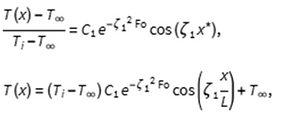
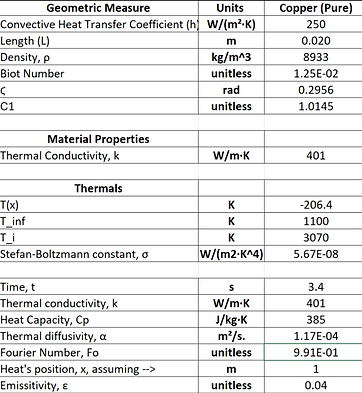
The heat transfer analysis applied both convective and conductive principles to model the thermal distribution along the vane, while material selection focused on evaluating three aerospace-grade candidates: Copper, Inconel 718, and Aluminum. Key inputs such as thrust duration, vane geometry, and material properties were compiled into structured Excel models to support the analysis. Convective heat transfer was simulated using a baseline coefficient of ℎ= 250 W/m^2⋅K with additional sensitivity studies conducted at ℎ= 175 and 235 W/m^2⋅Kto assess robustness. Validation confirmed consistent cooling trends and uniform temperature distribution along the vane length, reducing the risk of thermal deformation.

Results and Impact
Copper and Inconel 718 demonstrated superior thermal resistance, sustaining an average temperature of approximately 2900 K, while maintaining a uniform temperature distribution that reduced deformation risks and ensured vane stability across multiple launch cycles. Analytical insights from Excel-based modeling validated consistent cooling trends with distance, and a sensitivity analysis further confirmed the robustness and reliability of performance under varied operating conditions.



Design and Development of a Load-Cell Test Stand for Measuring Jet Vane Forces

Project Overview
This project involved designing and developing a load-cell-based test stand to measure thrust forces generated by jet vane thrust vector control systems. The aim was to create a stable, modular, and accurate testing platform that enables validation of different vane geometries and materials.
Objectives
-
Develop a safe and stable apparatus to test jet vane thrust vector control systems.
-
Accurately measure thrust forces across different vane designs.
-
Expand the testing platform’s applicability for both academic and industrial use.
Approach & Methodology
The gimbal test stand was developed as a ground-based platform to evaluate thrust vector control (TVC) by allowing a rocket motor and mount to pivot in pitch and yaw without requiring full flight. The design process focused on two-axis motion under controlled actuation, thermal resistance to hot exhaust, structural integrity under thrust, and repeatable testing with integrated sensors. Key constraints included budget limitations, vibration management, and identifying compatible actuators and data acquisition systems. Research on model rocketry setups informed the kinematic design of universal joints and 2-DOF linkages. Material evaluation considered heat and vibration tolerance, with PLA and aluminum selected for testing prototypes. Actuator options, load cells, PID control strategies, and real-time data acquisition methods were explored to finalize the design. Iterative virtual prototypes were created in SolidWorks, leading to the implementation of a rectangular clamp that improved strength, reduced setup space, and enhanced repeatability over thinner material designs. The final stand consisted of four simplified parts printed in PLA.

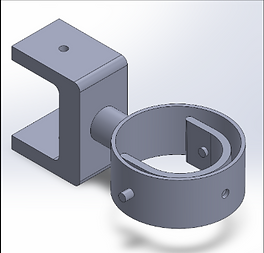
The vertical jet vane test stand was designed to validate vane functionality, material performance, and control mechanisms in model rockets, with scalability to larger aerospace systems. The design prioritized robustness, cost-effectiveness, accuracy, and minimal spatial footprint. Previous horizontal test stand designs informed the vertical configuration: horizontal setups posed safety hazards due to sideways flame and debris, required complex reinforcement for sensors and actuators, and demanded significant lateral space. The vertical orientation simplified load transfer, reduced space requirements, and improved operator safety. The initial design incorporated a model rocket, S-beam load cell, glide stops, and vehicle adapter. However, the S-beam was replaced with a circular (donut) load cell to improve dynamic load handling, side-load tolerance, thermal resistance, mounting simplicity, and long-term reliability without requiring precise axial alignment or custom brackets.


Results / Outcomes
The conceptual design successfully integrated with the rocket model, demonstrating controlled pitch and yaw motion in both directions. The test stand met the design scope, showing feasibility, robustness, and repeatability for ground-based TVC evaluation. The modular and compact design ensured ease of setup and safe operation for multiple test cycles. The vertical test stand achieved stable, repeatable measurements of vane forces while minimizing cost, spatial footprint, and complexity. The updated design with the donut load cell improved durability under thrust and thermal loads, allowing accurate performance data to be collected safely. Overall, the stand demonstrated effective integration of mechanical and measurement systems for validating jet vane functionality in a model rocket.


Mass & Structural Validation Analysis of a Rover Arm Under Payload Loading
