Landing Gear Design (MAJOR-Project MECE-2310)
Functional prototype simulating aircraft landing gear kinematics using SolidWorks and Meccano.

Introduction
The project aims to create a working prototype of an aircraft landing gear, using SolidWorks for virtual design and Meccano parts for physical construction, emphasizing structural functionality and movement.

Functions of Landing Gear
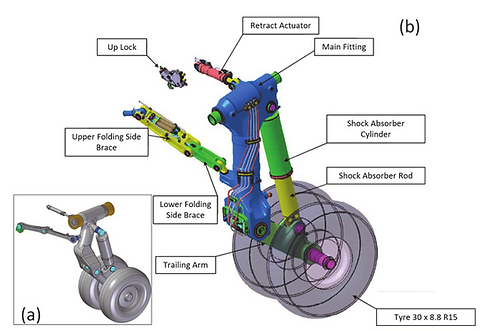
Landing gear provides suspension and shock absorption during taxi, takeoff, and landing. It protects the aircraft’s fuselage by absorbing and distributing landing forces, often with retractable mechanisms and hydraulic struts.
Materials
In real-world applications, landing gear systems are made from titanium, steel, CRES, and aluminum. The student prototype used available Meccano materials, including aluminum, rubber, and plastic, to mimic functional behavior.
Design Process (SPICE - S & P)
Using the SPICE framework, the team identifies the Situation (designing a sturdy landing gear) and Problem (limited budget, parts, and working space within 40x25x25 cm).

Design Process (SPICE - I & C)
The Investigation phase involved understanding the Meccano parts and exploring design iterations.
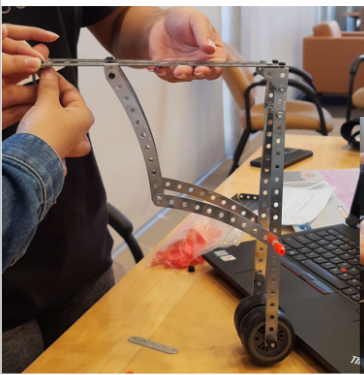
The Construction phase included testing multiple prototypes to determine the best mechanical setup.

Design Process (SPICE - E)
During Evaluation, the team identified areas for improvement: better fasteners, sturdier base materials, and motor speed control. Despite limitations, the prototype achieved manual up-lock and down-lock functionality.

Conclusion
Despite limited resources, the group successfully built a functional landing gear prototype. The project enhanced their understanding of landing gear systems, teamwork, and design iteration under real-world constraints.