
MPI Feeder Clamp Design
Non-metallic, inspection-safe clamping solution for Magnetic Particle Inspection (MPI) systems.

Project Context
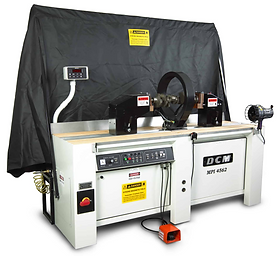
This project involved the design and prototyping of a Magnetic Particle Inspection (MPI) feeder clamp system to improve component handling during non-destructive testing procedures. The design was integrated as part of a broader quality assurance effort in an aerospace manufacturing setting.
The main goal was to create a robust, adjustable, and non-conductive clamping mechanism that could securely hold various part geometries during the MPI process without interfering with magnetic fields or testing accuracy.

Design Requirements
Key requirements included: electrical insulation, resistance to MPI fluid corrosion, quick part loading/unloading, and compatibility with different component sizes. The clamp also had to be operable in confined spaces and with gloved hands.
CAD Modeling & Simulation
The clamp system was modeled using Autodesk Inventor, with attention to ergonomic grip, clamping force distribution, and hinge durability. Finite Element Analysis (FEA) was conducted to evaluate load-bearing capacity and stress concentrations under clamping pressure.

Prototype & Testing
A functional prototype was 3D printed and manually tested with surrogate parts during simulated MPI routines. The clamp demonstrated consistent holding strength and ease of adjustment, withstanding exposure to test fluids and surface sprays.
The design process continued with another intern
Engineering Constraints & Challenges
Design challenges included minimizing clamp slippage under high-frequency vibration and ensuring the mechanism remained non-intrusive to the magnetic field. Solutions included integrating textured grips and using magnetic shielding for adjacent areas.
Results and Impacts
The feeder clamp improved operator efficiency and reduced setup time. Internal feedback from quality technicians highlighted improved handling and lower fatigue during inspections, validating the design’s real-world usability. Future enhancements include implementing a modular jaw system for varying part sizes, adding spring-loaded locking, and evaluating production feasibility with injection molding or industrial-grade additive manufacturing.
The design process continued with another intern
Conclusion
The MPI Feeder Clamp Design proved to be a low-cost, high-impact solution tailored to the specific needs of magnetic particle inspection in aerospace environments, enhancing test reliability and improving ergonomic safety for technicians.