
Life Cycle Analysis of a Cordless Power Drill
MAJOR-Project for MANE-4380U
Simulated Life Cycle Assessment on Housing and Battery of the 18V Drill

Project Foundation and Goals
This section establishes the technical and environmental baseline for an exhaustive Life Cycle Assessment (LCA) of an 18V cordless power drill. The study specifically compares the JOBMATE 18V and ToolTech 18V models, quantifying environmental impacts from raw material extraction through to end-of-life disposal. By selecting a product that integrates mechanical, electrical, and chemical systems, including over 15 different elements like thermoplastics, metals, and lithium-ion chemistry, the project aims to identify environmental "hotspots" and apply "Design for X" (DfX) principles to foster a circular economy.


Baseline Product Analysis
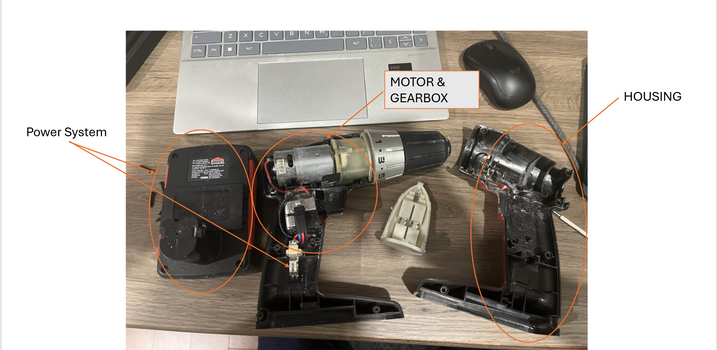
The initial phase focuses on a thorough definition of the product to understand exactly what is being assessed. It details the drill's complex subsystems, such as the steel planetary gearbox for torque conversion, the pulse width modulation (PWM) circuit for electrical control, and the lithium-ion battery pack for energy storage. This section includes a comprehensive Bill of Materials (BOM) and documents six major manufacturing processes, including injection molding and metal machining, while defining a "cradle-to-grave" system boundary over a 10-year functional lifespan.
Strategic Design Modifications
In this stage, the physical product is translated into computational models using SimaPro to identify where improvements can be made. Three primary modifications are proposed: enhancing the power system with battery recycling infrastructure, utilizing recycled metals and renewable energy for the motor drive train, and switching to post-consumer recycled plastics for the housing. An economic analysis validates these changes, demonstrating that transitioning to recycled materials can be cost-neutral or even provide a 3-5% cost reduction while enhancing supply chain resilience.

Environmental Validation and Impact
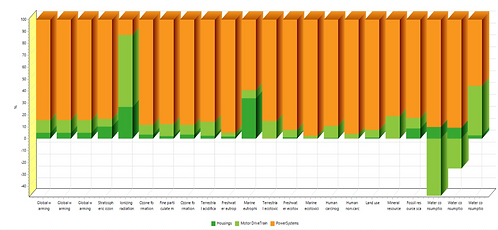
The final section quantifies the success of the proposed modifications across 18 impact categories using the ReCiPe 2016 methodology. The analysis identifies the original battery as a massive environmental hotspot, contributing 75-90% of the total impact in categories like Global Warming and Toxicity. The modified design results in spectacular improvements, achieving 60-80% reductions in toxicity and creating "negative environmental credits"—where the benefits of recycling and resource conservation actually outweigh the environmental costs of manufacturing the drill itself


Concluding Insights
The report concludes by synthesizing findings to prove that environmental responsibility and economic efficiency are complementary objectives. By systematically applying circular economy principles such as material substitution and renewable energy, the project demonstrates how a standard consumer product can be transformed from a significant environmental burden into a model for net resource conservation. These strategic insights emphasize the long-term benefits of sustainable design, including regulatory compliance and enhanced market positioning